At 91, Tobia Scarpa speaks about design the way a mathematician speaks about proof – with the certainty of someone who has tested his reasoning against time and found it holds. Among the defining voices of postmodern design, the Venetian-born designer established his studio with wife Afra in 1960. For the duo, design was about how spaces feel, and over five decades, their complementary instincts – his material curiosity, her extraordinary precision – produced more than 400 designs across furniture, lighting, architecture, and interiors. Each was the product of relentless dialogue. “Together we questioned proportions again and again,” Tobia said in conversation with GUBI CEO Marie Kristine Schmidt.
In praise
Legendary designer Tobia Scarpa in conversation with GUBI CEO Marie Kristine Schmidt
Marie Kristine Schmidt: The early 1970s were a charged moment for domestic design – a lot of experimentation, but also a lot of formality in how people actually lived. What were you and Afra responding to when you conceived Elogio?
Tobia Scarpa: In the early 1970s, the living room was still organized in a very rigid way: the sofa against the wall, the armchairs in their place, the room almost resembling a stage set. We were interested in breaking that rigidity. We wanted to introduce a system that could evolve alongside life in the home. People change, relationships change, homes change. Furniture should be able to adapt to these changes. This need has not disappeared over time; if anything, it has intensified. Today our homes serve many more functions than they once did. Elogio was conceived to allow freedom in transforming both space and function.
MKS: Elogio is the Italian word for “praise.” It is an unusual name for a sofa. What did you feel it deserved celebrating?
TS: It was praise of possibility. Not praise of an object, but of the freedom contained within it. Praise of domestic life, of conversation, of well-being. Elogio celebrates the quiet intelligence of everyday living.
MKS: Elogio's cushions are interchangeable and designed to be reconfigured by the people who live with the sofa. That feels very ahead of its time for 1974. Where did that impulse come from?
TS: It came from observing how people actually sit. No one sits in the same way all the time. Sometimes upright, sometimes sideways, sometimes lying down. We wanted the cushions to respond to these variations without requiring additional elements or mechanisms. The fact that they were identical was important. Repetition creates rhythm. Rhythm creates harmony. I cannot say whether it was ahead of its time. It simply seemed right to us.
View
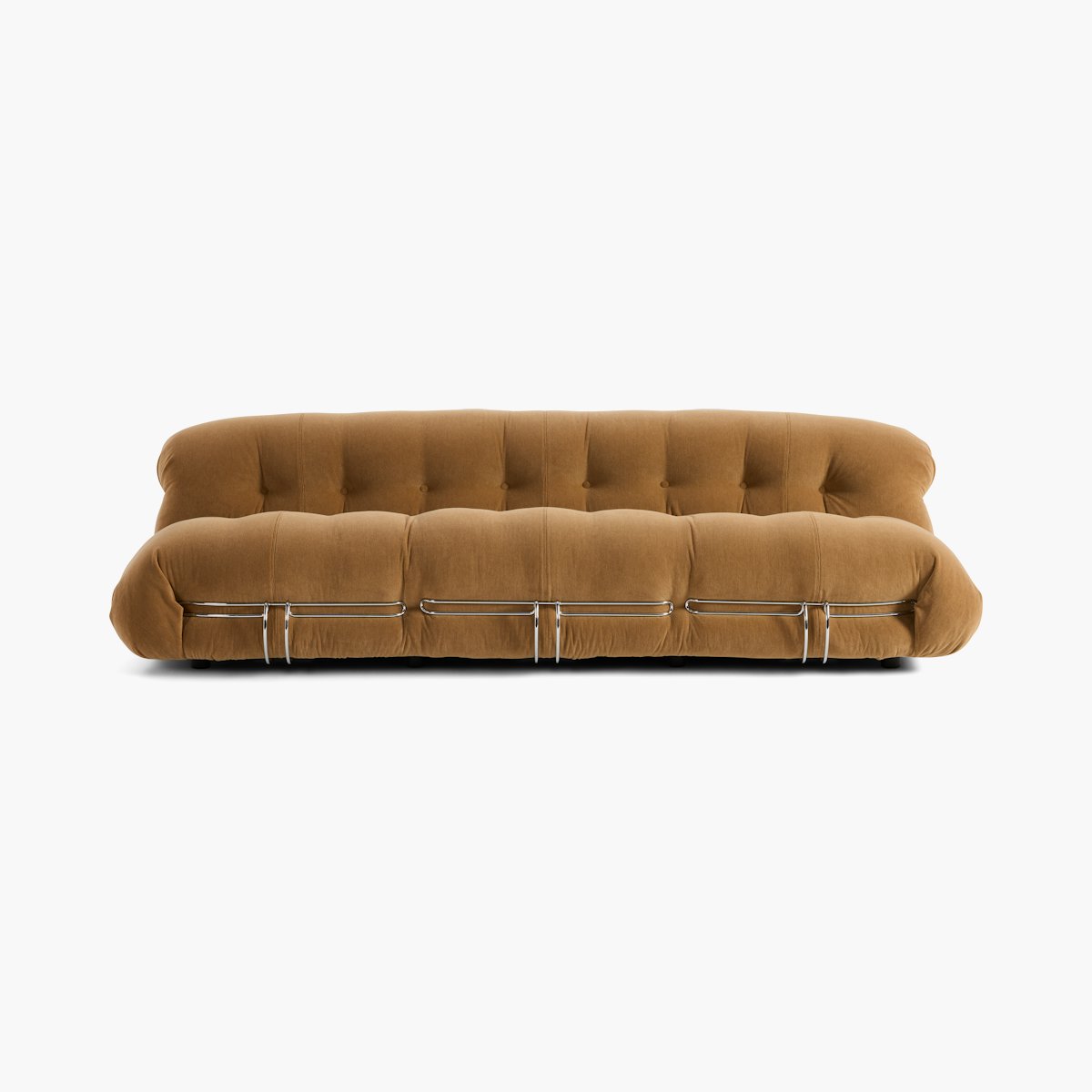



MKS: You once said Elogio was created to free objects from the constraints of traditional forms. Fifty years later, do you feel it succeeded?
TS: I believe it succeeded because it did not depend on the fashion of the moment. At the time, modularity seemed experimental. Today it feels natural. That tells me the principle was valid. When an object continues to adapt without losing its identity, it has achieved a certain autonomy. There are always limits worth challenging, but they are different in every era.
MKS: Elogio was a collaboration with Afra, as so much of your work was. When you look at the sofa today, where do you see her most clearly in it?
TS: In the equilibrium. Afra had extraordinary precision. She refined, measured, rebalanced. Together we questioned proportions again and again. Where instinct might lead in one direction, she ensured structural clarity. Elogio carries that shared language: curiosity contained within rigor. It is not possible to separate our contributions. Elogio is the result of that dialogue.
MKS: You've spent nine decades watching how people inhabit their homes. What do you think has fundamentally changed about that, and what hasn’t?
TS: Technology has changed. Speed has changed. The number of activities within a single space has multiplied. But the essential desires remain. People still want objects that resonate with their imagination and that stay with them over time. That has not changed, and I hope it never will.